
Riley County Criminal Docket Searches
Kansas runs its statewide system at Kansas CaseSearch. Pick District as the court, add the Criminal filter, then search by case number, party name, business name, or citation number. When the county control appears, select Riley County. Newer criminal case numbers look like RL-YYYY-CR-######. Anything filed before August 5, 2019 may instead carry YYYY-CR-######, with no RL prefix.
The web is not the only channel. The Riley Court Dockets page posts a settings PDF that updates each workday. A courthouse terminal can display public data or records missing online. Need a copy? The District Court Clerk handles record requests at 785-537-6364, though staff will not run general searches by phone. A written KORA request works for a public document not available another way.
- Choose District Court and Riley County in CaseSearch.
- Search the complete case number first, or use a party name and Criminal filter.
- Complete the human check and compare case type, year, and public parties.
- Use the Riley PDF to verify the date, judge, room, and setting type.
- Take the number to the terminal or clerk for documents, certification, or older material.
Riley County Criminal Case Numbers
Each part of the number means something. RL marks Riley County in the statewide system. The four-digit year shows when the case was filed, CR is the criminal code, and six digits give the sequence. Type the full string whenever you have it. That beats a name search for precision, especially when two people share a name.
Older Riley County criminal court dockets carry a wrinkle. The county joined Kansas eCourt in 2019, so pre-transition filings follow the earlier pattern. An old case may show public metadata online. But the filing itself stays off the web. In that situation, try the courthouse terminal and ask the clerk about the file. Remember: an absent online image does not mean the document never existed.
Best first search: Use the full case number. For a name search, narrow by Riley County, Criminal case type, and filing dates.
Criminal Dockets: What They Show
Think of the Riley settings report as a calendar, not a full ledger of case events. Its columns cover case number, date and time, courtroom, judge, setting type, party role, connection party, attorney, and an access or status note. An entry may read In custody, Zoom, In person, or Sealed. Charges, bond items, financial entries, plea papers, and final judgments are not guaranteed to appear on that PDF at all.
| Case number | A newer number such as RL-2025-CR-000123, or the older no-prefix form. |
|---|---|
| Setting | First Appearance, Arraignment, Preliminary Examination, Plea Hearing, Trial, Sentencing, or another event. |
| Time and place | The date, time, courtroom, and judge tied to that setting. |
| People and roles | Public party-role, connection-party, prosecutor, defendant, and attorney fields where shown. |
| Access note | A logistics or restriction note such as Zoom, In person, In custody, or Sealed. |
For the charge text, journal entry, plea, order, or final result, open the detailed case-information view or the courthouse file when public. A label on a calendar never replaces the filed record.
Riley County Criminal Setting Terms
Many labels on the Riley County criminal docket name an event, not a result. "Arraignment - Status" is just a setting. "Diversion - Status" alone does not show a dismissal. A sentencing date is a date, not the sentencing order itself.
- Preliminary Examination
- A setting used to address whether the case proceeds beyond the preliminary stage.
- Pretrial Conference
- A setting before trial for case posture, motions, and trial planning.
- Plea Hearing
- A setting for a plea. The resulting plea and court action belong in the case record.
- Appeal - Municipal
- A city-court matter that has entered the Riley District Court structure.
- Disposition
- The result or closing action, distinct from a scheduled hearing.
Note: Before relying on the posted calendar, confirm any changed setting with the Riley District Court Clerk or the assigned division.
Criminal Case Stages on the Docket
A Riley County criminal court docket builds up as the case moves. Early public entries often show a filing and a First Appearance. Arraignment comes next. Preliminary examination and pretrial settings may follow, and motions can generate their own hearings and orders. A plea or trial can bring a disposition. A conviction opens the door to sentencing and later probation events.
Docket flow: Filing › First Appearance › Arraignment › Preliminary or Pretrial Settings › Plea or Trial › Disposition › Sentencing
Timing rules add useful context. Under the 21st Judicial District rules, felony trial dates get set at arraignment. Counsel should bring calendars. A preliminary-hearing continuance motion generally needs filing at least three days ahead absent good cause. Motions to dismiss or suppress generally need filing at least 30 days before trial unless the judge says otherwise.
Riley County Criminal Docket Roles
Two offices split the work in a Riley County criminal case. The current court contact page lists Barbara Cragg as Clerk of Court. Her office keeps the state trial-court docket and file. It staffs the counter, arranges terminal access, and answers copy questions. The clerk cannot decide whether a judgment is still current. Nor can that office settle any other legal question.
Prosecution belongs to a different office. The Riley County Attorney criminal page lays out its criminal and traffic prosecution work. Located at 105 Courthouse Plaza, that office takes questions about charges or diversion. Reach it at 785-537-6390. It does not issue certified criminal dockets. The official page itself shows how that role is framed.
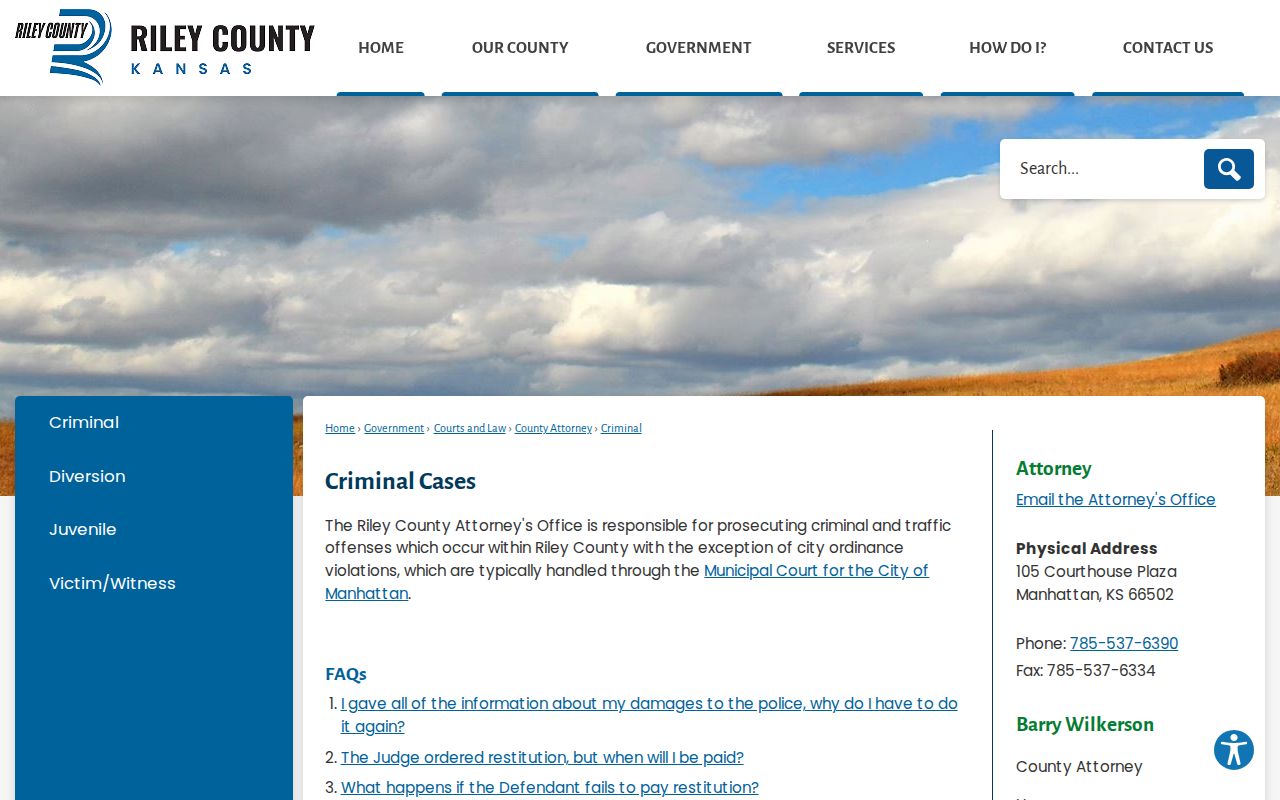
The lesson is simple. Record requests go to the court clerk. Charging and diversion questions go to the prosecutor.
Riley County Criminal Docket Courts
Felonies and state misdemeanors land in Riley County District Court, part of the 21st Judicial District alongside Clay County. Riley fields three district-judge divisions and two district-magistrate divisions. All sit inside the unified District Court structure. Kansas CaseSearch is the first online stop, and the Riley report names the judge and courtroom for each hearing.
Ordinance violations begin in municipal court instead. Manhattan runs a city-linked search portal. Ogden, Riley, Leonardville, and Randolph post no public portal, so contact the city office directly. An appealed municipal case may show up later as "Appeal - Municipal." Federal charges travel a separate road through PACER and the U.S. District Court for the District of Kansas.
| Matter | First source | Fallback |
|---|---|---|
| State felony or misdemeanor | Kansas CaseSearch | Riley terminal and clerk |
| Manhattan ordinance case | Municipal Record Search | Manhattan Municipal Court |
| Other city ordinance case | City municipal court | City office |
| Federal criminal case | PACER | District of Kansas clerk |
Riley County Youth Criminal Dockets
Juvenile matters stay private in Riley County, even when a program has a public name. The Youth Court Immediate Intervention Program is real and local. Its existence opens no broad window onto youth court records. Kansas keeps juvenile felony, misdemeanor, and infraction types out of the portal. Pre-file intervention categories sit outside it too. Grand-jury, search-warrant, and inquisition records sit outside ordinary portal access. Certain transfer records do too. The official Riley program page lays out the local schedule and purpose.
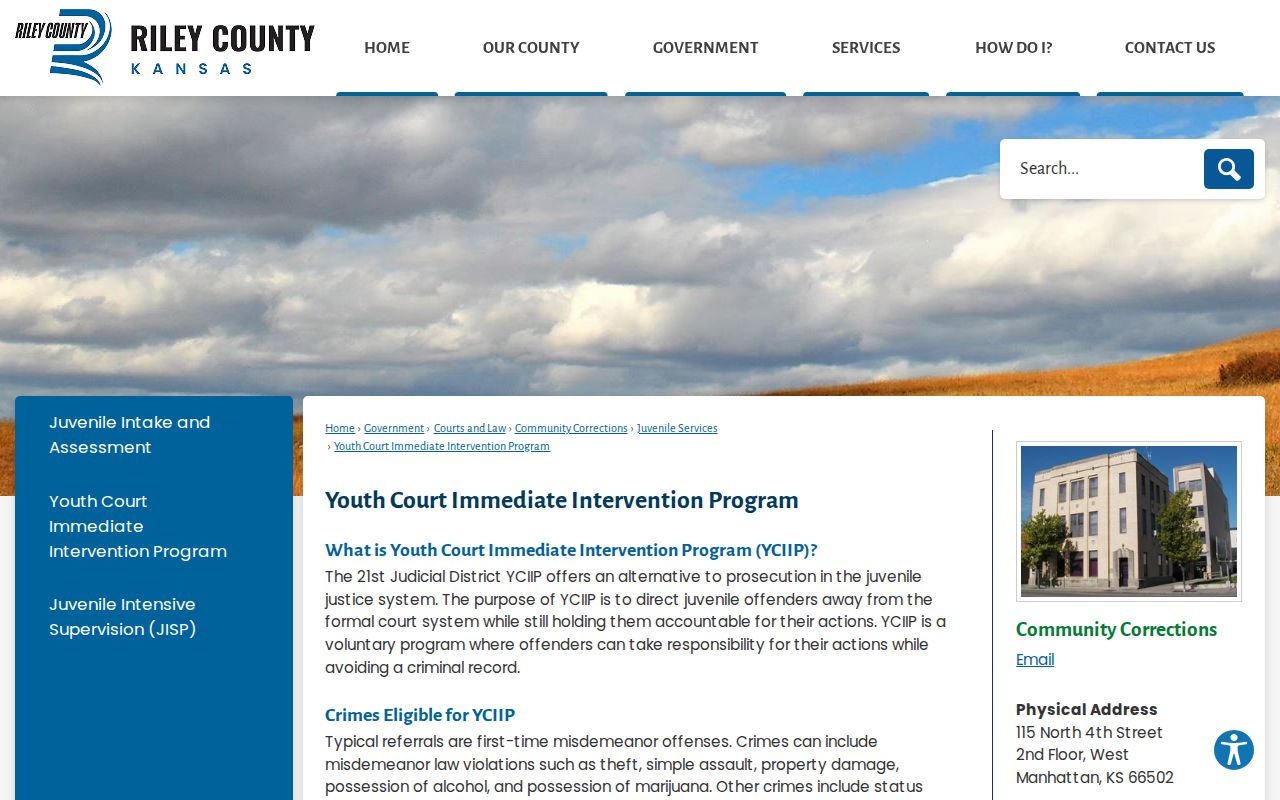
Program details tell you nothing about a youth's case status. So ask the clerk which lawful rule applies. Do not piece together restricted facts from scattered sources.
Missing Riley County Criminal Dockets
A blank docket search does not prove there is no case. Check the whole case number, the RL prefix, filing year, case type, and court level. Older Riley County records may still use the pre-2019 format, so retry that. Hunting a coming hearing? Search the Riley PDF by last name or the final digits of the number. A city ordinance matter may live in municipal court instead.
If nothing turns up, try the courthouse terminal. Ask the clerk about a specific document. Use the Kansas Judicial Branch KORA form when a public copy request fits. Copies can arrive by email, mail, pickup, or fax. Riley County sets no posted court-copy fee. Confirm the cost and steps with the clerk.
Note: A KORA request cannot override a seal, expungement, court order, or statutory restriction.
Access Rules for Criminal Dockets
Kansas rules govern what the public can see. Access laws do the same for a Riley County criminal court docket. Online information is not the certified record. Some public material exists only at the courthouse. Nonpublic material stays unavailable online and at the terminal alike. A row on the calendar does not promise every filing behind it is online.
Key access rules:
Kansas Supreme Court Rule 22 distinguishes internet access, terminal access, and nonpublic records.
Kansas Supreme Court Rule 23 governs filing designations and sealing procedure.
K.S.A. 45-221 supplies the Kansas Open Records Act exemption framework.
Sealed, expunged, investigative, juvenile, and grand-jury material may be withheld. The clerk can point you to the right channel. The clerk cannot disclose protected content. The clerk cannot hand down a legal ruling. When accuracy matters, verify a public entry with Riley County District Court.